


Toronto Art Appraisal

We recently had the pleasure to meet with a Toronto client to prepare a written appraisal report of their International Art Collection. Included were numerous lovely originals by renowned painters including this impressive composition by Philippe Dodard.
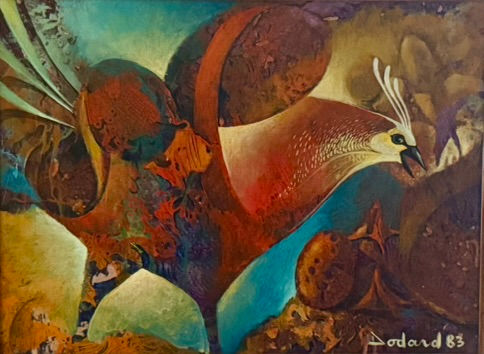
Philippe Dodard (b.1954, Haitian)
Pheasant on an abstract ground
Acrylics on board
Signed and dated ‘83 lower right
25.5cm x 33cm (10” x 13”)
Toronto Art Appraisal - Philippe Dodard is an important Haitian painter, graphic artist, sculptor, and multidisciplinary creator whose work combines modern artistic ideas with the cultural traditions of Haiti. Born in Port-au-Prince in 1954, Dodard has developed a distinctive style based on strong lines, geometric and angular forms, expressive colours, and symbolic figures. His art has been exhibited in Haiti and internationally, particularly throughout the Americas and Europe. He is recognized as an artist who has helped demonstrate how Haitian art can be both deeply connected to its cultural history and strongly modern in its visual language.
Dodard's interest in art began at a young age. In 1966, while attending the Petit Séminaire Collège Saint-Martial, he received first prize in drawing. His early education was important because it encouraged his natural talent and helped establish art as an important part of his life. As a teenager, he became involved with PotoMitan, an important Haitian art school associated with artists such as Jean-Claude “Tiga” Garoute, Patrick Vilaire, and Frido Casimir. At PotoMitan, Dodard was exposed to experimental approaches to art and to Haitian cultural imagery. He later entered the Academy of Fine Arts in Port-au-Prince in 1973.
Education was not limited to traditional fine art for Dodard. He also developed an interest in graphic design and visual communication. In the 1970s, he worked as a layout artist and advertising illustrator and eventually founded a studio specializing in audiovisual graphic arts. In 1978, he received a scholarship to study at the International School in Bordeaux, France, where he specialized in pedagogical graphic design. This experience had an important effect on his artistic development. His training in graphic design can be seen in the organized shapes, carefully constructed compositions, and powerful visual symbols that appear in his paintings.
One of the most distinctive features of Dodard's art is his use of angular forms. Instead of creating figures that look completely realistic, he often reduces people and objects to simplified shapes, lines, and symbols. Art critics have described his compositions as architectural because the forms appear to be carefully arranged within the picture rather than placed according to traditional perspective. This gives his paintings a sense of structure while still allowing them to remain expressive and mysterious.
Colour is equally important in Dodard's work. His paintings can contain intense reds, oranges, blues, yellows, blacks, and earth tones. Rather than simply reproducing what can be seen in nature, he uses colour to create emotion and atmosphere. His colours can make a painting feel energetic, spiritual, dramatic, or mysterious. The relationship between colour and shape is central to his artistic language. A strong outline may define a figure, while contrasting colours give that figure emotional or symbolic power.
Dodard's work is also connected to Haitian cultural traditions. His early experiences at PotoMitan introduced him to the visual richness of Haitian culture, including the influence of African and Indigenous American imagery and the symbolic forms associated with Haitian Vodou. His art does not simply copy traditional symbols. Instead, he transforms cultural ideas into a modern visual vocabulary. This combination of tradition and experimentation is one reason his work is significant within contemporary Haitian art.
Another important aspect of Dodard's career is that he has never limited himself to painting. His artistic practice includes sculpture, decorative work, ironwork, graphic design, and jewelry. This multidisciplinary approach demonstrates his interest in exploring how artistic ideas can move between different materials and forms. His strong drawing skills provide a foundation for many of these different activities. Whether he is working on a canvas, a sculpture, or a graphic composition, he uses line, form, rhythm, and symbolism to communicate ideas.
Dodard has also contributed to Haitian society outside the gallery. From 1983 to 2003, he produced political caricatures for the New Year's edition of the Haitian newspaper Le Nouvelliste. This work demonstrates another side of his creativity: the ability to use images to communicate social and political ideas to a broad audience. He also became involved in arts education and cultural development. His work in education reflects his belief that art is not only something to be displayed but also a way of developing creativity and cultural understanding.
The international recognition of Dodard's work further demonstrates his importance. His paintings have appeared in exhibitions across Europe and the Americas, and his artistic influence has extended beyond the traditional art world. In 2012, his paintings inspired American fashion designer Donna Karan's Spring collection, and Dodard participated in a related exhibition with her at the Museum of Contemporary Art, North Miami. This connection between Haitian visual art and international fashion illustrates the broad appeal of his distinctive aesthetic.
Dodard has also played a role in connecting Haitian art with Africa. In 2018, he participated in the inauguration of the Museum of Black Civilizations in Dakar, Senegal. He was honored as a Knight of Senegal's National Order of the Lion, and his African Memory collection became part of the country's national museum collection. These achievements show that his work can be understood not only within Haiti but also within larger conversations about African, Caribbean, and diasporic identity.
A particularly important event in Dodard's career was the 2010 earthquake in Haiti. His work after the disaster included involvement in the reconstruction of the historic Marché Florvil Hyppolite in Port-au-Prince, where he served as an artistic adviser. The earthquake had a devastating effect on Haitian society, and artists responded in different ways through their work and public activities. Dodard's participation demonstrates how his role extended beyond painting and into the preservation and reconstruction of Haiti's cultural environment.
Overall, Philippe Dodard is significant because he represents a meeting point between Haitian tradition and modern artistic expression. His work does not fit easily into a single category. It contains elements of abstraction, expressionism, graphic design, symbolism, and cultural imagery. His angular figures and powerful colours create a recognizable visual identity, while his interest in Haitian culture gives his work a deeper meaning.
Dodard's career also shows the importance of versatility in art. He has worked as a painter, illustrator, designer, sculptor, educator, and cultural contributor. His success demonstrates that Haitian art can communicate local experiences while also participating in international conversations about modern art and identity. Through his paintings and other creative work, Dodard has created a visual language that is both personal and connected to the history and culture of Haiti.
Philippe Dodard therefore deserves recognition as one of the notable figures in modern Haitian art. His ability to combine graphic precision with expressive freedom makes his work distinctive. His use of colour, angular forms, symbolism, and cultural references creates paintings that are visually powerful while inviting viewers to think about identity, memory, spirituality, and society. His international exhibitions, work in different artistic media, and contributions to cultural education have expanded his influence beyond Haiti. Most importantly, Dodard shows that modern art does not have to abandon cultural heritage. Instead, tradition can become a source of creativity, allowing artists to reinterpret the past and create new forms of expression for the present.


Comments