


Toronto Art Appraisal

We recently had the pleasure to meet with a local client and prepare a written appraisal report for their fine art collection, consisting of numerous quality originals by renowned International artists, including this lovely still life original oil painting by Hungarian painter Sandor Mohi.
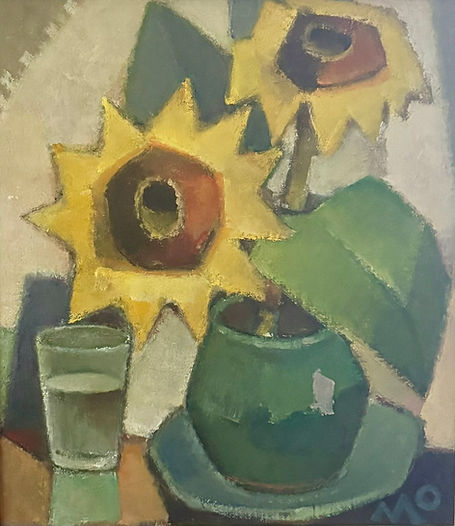
Sandor Mohi (1902-2001, Hungarian)
Still Life - Potted flower and striped cup on a table
Oil on board
Signed lower right
Signed on reverse and inscribed ‘Mohi Pinxit’
59.6cm x 49.5cm (23½” x 19½”)
Toronto Art Appraisal - Sandor Mohi, also known as Sándor Mohy or Alexandru Mohi, was a Hungarian-Romanian painter and art educator whose career extended across much of the twentieth century. Born in 1902 in Dercen and dying in 2001 in Cluj-Napoca, Mohi became an important figure in the artistic and educational life of Transylvania. His career connected several important artistic centres, including Satu Mare, Baia Mare, Cluj, and Bucharest. He is remembered particularly for his paintings, including landscapes, still lifes, and works displaying modernist and Cubist influences.
Mohi grew up in Satu Mare, a city with a lively cultural environment and a significant Hungarian and Romanian artistic tradition. His early interest in art developed despite limited financial resources. One of the most important influences on his development was the painter Aurel Popp. Mohi worked under Popp's guidance in Satu Mare and accompanied him to Baia Sprie, gaining valuable practical experience outside the classroom. His early exposure to the artistic environment of Baia Mare was also significant. Records indicate that he worked there in 1924, 1926, and 1927, placing him within the broader artistic tradition associated with the Baia Mare artists' colony.
Between 1926 and 1930, Mohi studied at the School of Fine Arts in Cluj. His teachers included Aurel Ciupe, Catul Bogdan, and Anastase Demian, according to Romanian sources. Another Hungarian art reference identifies additional teachers associated with his education, including Sándor Papp, Ferenc Ács, Aurel Ciupe, and Sándor Szopos. These different accounts reflect the multilingual and multicultural artistic environment in which Mohi developed. In 1929 he obtained a qualification as a drawing teacher.
Mohi's professional life combined painting with teaching. From 1929 to 1937 he taught drawing at the Reformed High School in Satu Mare. He was not simply an instructor, however; he also participated actively in the cultural life of the city. Later, he taught in Dej, and in 1949 he was appointed to the Institute of Fine Arts “Ion Andreescu” in Cluj, where he remained a professor of painting until 1970. His long teaching career made him an influential figure for younger generations of artists.
Mohi's artistic career officially emerged in the late 1920s. While still a student, he exhibited at the Official Salon in Bucharest in 1928. From then on, he participated in group and collective exhibitions in Satu Mare, Cluj, Bucharest, Oradea, and Budapest. He also held individual exhibitions, including exhibitions in Satu Mare and Dej in the 1930s and later shows in Satu Mare and Cluj. His work therefore circulated across a broad geographical area rather than being confined to one local artistic community.
One of the most interesting aspects of Mohi's art is the variety of subjects and styles associated with his work. He painted landscapes, towns, interiors, and still lifes. Auction records, for example, include works titled Street with Church in Dés, Town in the Winter, and Studio Still Life with Sunflowers. These titles suggest an artist interested both in the surrounding environment and in the quieter world of objects and domestic subjects.
Mohi is also associated with modernist and Cubist approaches to painting. Art-market descriptions characterize him as a painter particularly known for Cubist works, emphasizing his use of strong colour and broad, energetic brushwork. A surviving example described as a Cubist still life is an oil painting on thick cardboard. Such works demonstrate his willingness to move beyond straightforward naturalistic representation and to organize forms through simplified shapes, colour, and expressive brushwork.
His still lifes are particularly revealing of this approach. Instead of treating ordinary objects merely as things to be copied, Mohi could transform them into arrangements of colour, shape, light, and texture. A documented work, Still Life with Jug and Lemon, painted in oil on cardboard in 1990, has been described as conveying a warm sense of light, tranquillity, and balance. The fact that Mohi continued producing such work late in life demonstrates the persistence of his interest in familiar subjects and painterly experimentation.
At the same time, Mohi's career cannot be reduced simply to Cubism. His work developed over many decades and existed within the changing artistic conditions of twentieth-century Romania and Transylvania. A 1962 issue of the Romanian art journal Arta Plastică reproduces or discusses a work by Sandor Mohi titled Bicicliști (Cyclists), showing that his work was also presented within the contemporary artistic discourse of the period.
His long career also reflects the complicated cultural identity of Transylvania. Mohi is variously identified in sources as Sándor Mohy, Sandor Mohi, and Alexandru Mohi. These variations are not necessarily evidence of different artists; they reflect the multilingual environment in which he lived and worked. Art databases and specialist sources consistently connect these names with the same artist, born in 1902 and deceased in 2001.
Recognition of Mohi's importance increased as his career progressed. Retrospective exhibitions were organized in Cluj in 1975 and 1977, and a major retrospective was held at the Sala Dalles in Bucharest around the time of his seventy-fifth birthday. These exhibitions demonstrate that he was regarded not merely as a local painter but as an artist with a substantial national career. His achievements as both artist and educator were also recognized through various awards for his creative and pedagogical work.
Mohi lived to the age of ninety-nine, giving him an unusually long artistic life. His career passed through numerous phases of European history, from the interwar period and the Second World War to the communist era and the final years of the twentieth century. Through all these changes, painting remained central to his identity. His work illustrates how an artist could combine regional traditions, academic training, modernist experimentation, and a commitment to education.
Today, Sandor Mohi may not have the international fame of better-known twentieth-century Hungarian or Romanian artists, but his career provides an important window into the artistic history of Transylvania. His paintings connect the traditions of Satu Mare and Baia Mare with the academic environment of Cluj and the wider exhibition world of Bucharest and Budapest. His landscapes and still lifes reveal an enduring interest in everyday surroundings, while his Cubist and modernist works show a willingness to experiment with form and colour.
Mohi's greatest significance may therefore lie in the combination of his artistic and educational achievements. He was not only a painter who exhibited widely; he was also a teacher who helped sustain artistic culture in Cluj and elsewhere. His nearly eight-decade-long life and his continued involvement with art made him a witness to enormous changes in European culture. His paintings, exhibitions, and teaching career together form a substantial legacy that deserves greater attention from historians, collectors, and people interested in the rich artistic heritage of Transylvania.

Comments