


Art Appraisal

A recent Belleville area client required an insurance appraisal report for his fine art collection. He had numerous high value and fine pieces by highly sought after and rare artists, including an original by highly acclaimed American 19th Century Naturalist painter, Samuel A. Kilbourne.
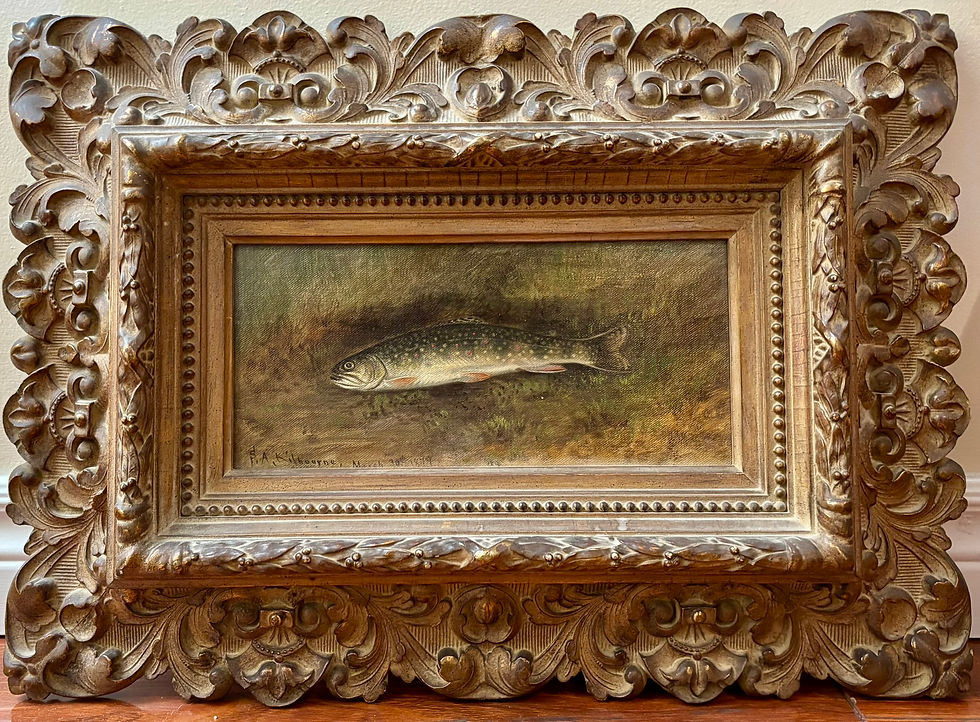
Samuel A. Kilbourne (1836-1881, American)
Trout on the bank
Oil on canvas
Signed and dated March 30th, 1879 lower left
15.2cm x 31.8cm (6” x 12½”)
Art Appraisal - Samuel A. Kilbourne painting
Samuel A. Kilbourne (sometimes printed as Samuel Kilbourne) was an American artist born in 1836 in Bridgetown, Maine, a coastal town with close ties to fishing and maritime life. He lived and worked through much of the latter half of the 19th century and died in May 1881, shortly after completing his most ambitious project. Kilbourne is best known for his highly detailed and beautiful paintings and illustrations of fish—works that reflect both scientific precision and artistic sensitivity. Though not as widely known as some of his more famous contemporaries in the fine-arts mainstream, Kilbourne made a distinctive contribution to American natural history art, blending traditional landscape painting with zoological accuracy. His illustrations have been widely circulated, collected, and exhibited long after his death.
Early Life and Artistic Roots
Kilbourne’s early years in Maine played a central role in shaping his artistic focus. Growing up near the Atlantic and surrounded by the landscapes and waters that sustained local communities, he developed a keen eye for both the environment and the aquatic life within it. The influence of Maine’s rugged coasts and inland waterways would remain a defining motif throughout his artistic career.
Initially, Kilbourne trained and worked as a landscape painter—a respected genre in the 19th century that celebrated the beauty of the American environment. During this period, he honed the techniques of traditional painting: composition, rendering of light and shadow, and the evocation of natural settings. His landscape work prepared him technically for a more specialized direction late in his career.
A Turning Point: Fish Painting and Natural History
Around 1858, Kilbourne made a decisive shift: he began to focus on painting fish and aquatic subjects with increasing dedication. This transition wasn’t just a matter of changing subject matter—it represented a blending of artistic skill and scientific observation at a time when both disciplines were evolving in the United States. Natural history illustration was gaining importance, as scientists, anglers, and publishers all sought visual representations that were both accurate and aesthetically compelling.
Kilbourne’s fish paintings stood out because they were not merely diagrams for scientific study. Instead, they depicted fish in dynamic, lifelike settings—engaged in natural behaviors such as swimming, feeding, or striking at a fishing line. These were visual narratives that communicated not just form and color, but also movement, personality, and habitat. The appeal of his work was broad: scientists admired the accuracy of his representations; sportsmen and anglers valued the connection to their pastimes; and art lovers appreciated the painterly quality of his scenes, which combined detailed foreground subjects with evocative background landscapes.
“Game Fishes of the United States” (1878-1881)
Kilbourne’s most significant and enduring work is undoubtedly his series of paintings that were published under the title Game Fishes of the United States. Created in the final years of his life and published in 1879 in New York, this collection of chromolithographs (color prints) marked a landmark in both artistic and natural history publication.
The project brought together his two primary strengths:
Landscape artistry—each illustration places the fish within an environmental context that evokes the species’ typical setting.
Fish depiction—the individual fish are rendered with remarkable precision, capturing not only anatomical detail but also the subtle hues and textures of scales, fins, and forms.
The book features dozens of images depicting a wide range of game fish—species such as mackerel, striped bass, trout, and kingfish—each portrayed in action or in repose. Unlike stiff, static scientific plates common at the time, Kilbourne’s compositions convey vibrancy, movement, and life. The work was published with accompanying text (often by experts like ichthyologist George Brown Goode) and was designed for both sporting audiences and scientific aficionados. Contemporary reviews noted that Kilbourne had achieved a rare balance between “accuracy in details of form and coloring required by the naturalist” and “freedom of style, delicacy of handling, and naturalness of surroundings demanded by the artist.” Despite its prestige, the publication was expensive and limited in distribution, making original editions highly prized by collectors today.

Artistic Style and Technique
Kilbourne’s work can be appreciated on multiple aesthetic levels:
Landscape Elements: The background scenery in his fish plates demonstrates an understanding of depth, light, and space that aligns with 19th-century American landscape painting traditions. Rivers, riverbanks, foliage, and boats are depicted with a softness and realism that place the subjects in real habitats.
Fish Forms: Fish are rendered with meticulous attention to anatomical accuracy—proportions, fin structures, and the sheen of scales are depicted with care. The integration of fish within dynamic compositions (e.g., hooked on lines, leaping from water) adds drama and narrative engagement.
Use of Chromolithography: The choice of chromolithography—a relatively new technique in the late 19th century—allowed for vivid, multi-colored prints that reproduced the original paintings with a richness appealing to both artistic and sporting markets.
Legacy and Influence
Samuel A. Kilbourne’s contributions have been recognized in both artistic and natural history contexts:
His illustrations were included in exhibitions such as “Fish Stories: Early Images of American Game Fish” at institutions like the Crystal Bridges Museum of American Art, highlighting their cultural and aesthetic value in American art history.
Today, Kilbourne’s chromolithographs and individual works appear in auctions, collections, and private holdings, commanding interest from collectors of sporting art, natural history prints, and 19th-century American art.
Art historians and collectors regard his work as part of a broader 19th-century American interest in depicting nature realistically and romantically, bridging science and art in an era before photography dominated natural history documentation.
Although Kilbourne’s name might not be as widely recognized as some landscape painters of his time, his niche remains significant—he helped shape the visual vocabulary of American natural history illustration and sporting art at a formative moment in the nation’s cultural development.
Conclusion
Samuel A. Kilbourne remains an important figure in American art, particularly for his unique blend of natural history precision and artistic expression. From his early landscape work to his celebrated fish illustrations for Game Fishes of the United States, Kilbourne’s career reflects a passionate engagement with nature and an artistic vision that brought aquatic life to vivid, unforgettable visual form. His legacy endures in museums, collections, and the continued appreciation of artists and anglers alike who value his contributions to both science and art.


Comments