


Art Appraisal Group of Seven Artist
- elliotmelamed

- Feb 24
- 4 min read
We met recently with a local GTA client in order to prepare a written art appraisal report for his personal collection, which included several Group of Seven artist pieces.

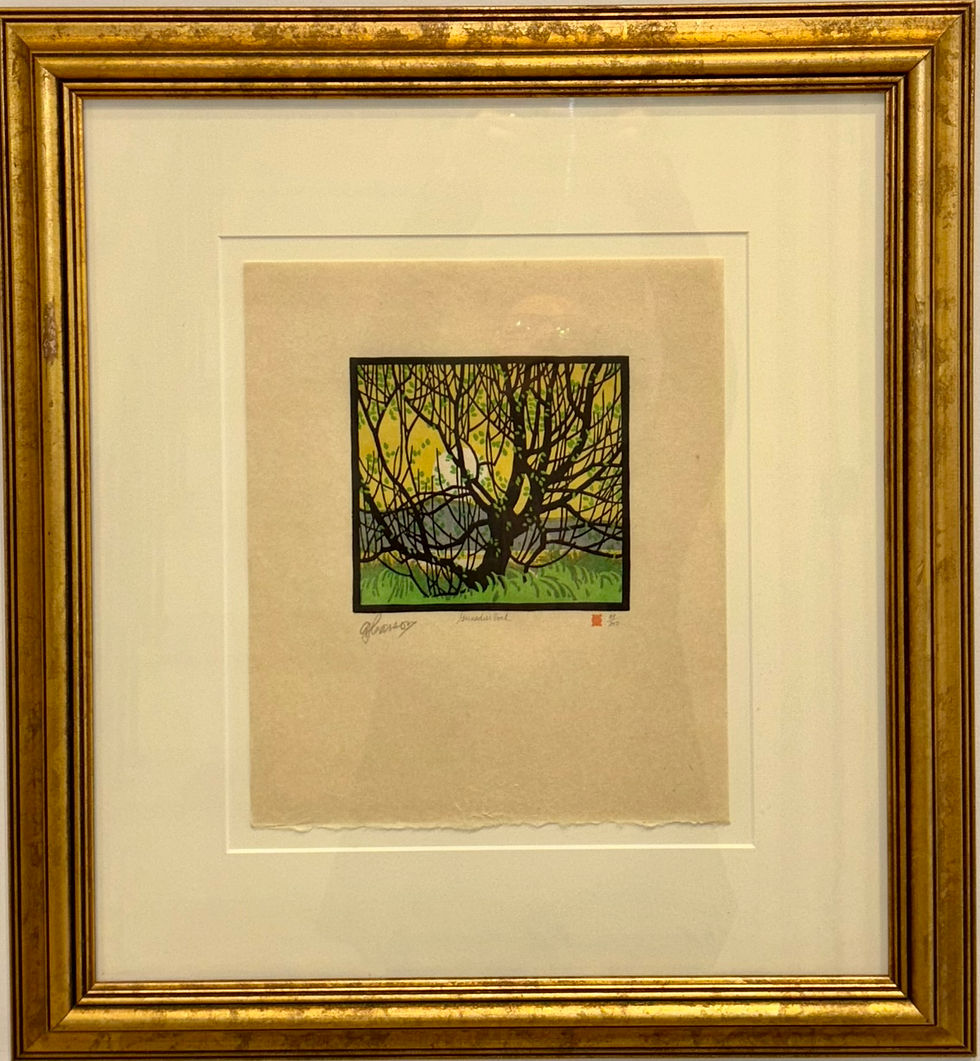
Art Appraisal Group of Seven Artist - Alfred Joseph Casson (1898–1992), a prominent member of the Group of Seven, is most often celebrated for his watercolours and paintings of the Ontario landscape. Yet an essential, and sometimes underappreciated, aspect of his artistic practice lies in his linocut prints. Casson’s linocuts represent a crucial intersection of modernist design principles, graphic clarity, and a distinctly Canadian vision of landscape. Through this medium, Casson distilled nature into simplified forms and bold contrasts, revealing his deep interest in structure, rhythm, and composition.
Casson began producing linocuts in the 1930s, a period when printmaking was gaining renewed attention among modern artists. Linocut, a relief printing technique similar to woodcut but using linoleum instead of wood, appealed to artists interested in clean lines and flat areas of colour. For Casson, linocut offered a way to strip the landscape down to its essential geometry. This aligned closely with the Group of Seven’s broader aim: not merely to depict nature, but to interpret and reshape it into a new visual language expressive of national identity.
Unlike the rugged, expressive brushwork associated with painters such as Lawren Harris or A. Y. Jackson, Casson’s approach was more controlled and architectural. His linocuts are characterized by crisp outlines, carefully balanced compositions, and a restrained palette. Often printed in black and white or limited colours, these works emphasize pattern and structure over atmospheric detail. Trees become rhythmic verticals, hills flatten into layered bands, and buildings are reduced to simple geometric shapes. The result is a landscape that feels simultaneously natural and designed.
Casson’s training as a commercial artist played a significant role in shaping his linocut style. Early in his career, he worked as a graphic designer and layout artist, most notably at the firm Rous and Mann, where he later became art director. This professional background sharpened his sense of visual economy and reproducibility—key qualities in printmaking. His linocuts demonstrate an awareness of how images communicate quickly and clearly, qualities essential in both commercial design and relief printing.
Many of Casson’s linocut subjects reflect his enduring fascination with small towns and rural architecture in southern Ontario. Churches, houses, barns, and quiet streets recur throughout his prints, often nestled into rolling landscapes or framed by stylized trees. These scenes convey a sense of order and calm, suggesting a harmonious relationship between human settlement and nature. Unlike more dramatic wilderness imagery, Casson’s linocuts celebrate the modest, inhabited landscape, presenting it as stable, enduring, and thoughtfully constructed.
The technical limitations of linocut also contributed to Casson’s distinctive aesthetic. Because linoleum does not support fine detail as easily as wood engraving, artists must rely on bold shapes and decisive cuts. Casson embraced these constraints, allowing them to guide his artistic choices. Negative space becomes as important as positive form, and contrasts between light and dark create visual impact. In many prints, the sky is rendered as a flat, unmodulated shape, while foreground elements are tightly organized, reinforcing a sense of balance and control.
Casson’s linocuts also reveal his engagement with international modernist trends. The emphasis on flatness, abstraction, and formal design aligns his work with European printmakers and the broader modernist movement of the early twentieth century. However, Casson never abandoned representation entirely. His prints remain rooted in recognizable places and motifs, maintaining a strong connection to the Canadian environment. This balance between abstraction and representation is one of the defining strengths of his linocut practice.
While Casson did not produce linocuts in the same volume as some print-focused artists, the works he did create had a lasting influence. They were widely exhibited and collected, and they helped legitimize printmaking as a serious artistic medium in Canada. At a time when painting dominated the national art conversation, Casson’s linocuts demonstrated that prints could convey depth, meaning, and originality equal to that of larger, more traditional works.
Moreover, the accessibility of linocuts aligned with Casson’s belief in art as a public good. Prints could be produced in editions, making them more affordable and widely distributed than unique paintings. This democratic aspect resonated with Casson’s quiet, community-oriented vision of Canadian culture. His linocuts invite viewers into a shared landscape—familiar, ordered, and contemplative.
In assessing A. J. Casson’s linocut prints, it becomes clear that they are not merely secondary works or experiments, but a central expression of his artistic philosophy. Through linocut, Casson refined his interest in design, structure, and clarity, producing images that are both modern and deeply rooted in place. These prints stand as elegant summaries of his broader contribution to Canadian art: a vision of landscape shaped by discipline, observation, and a profound respect for form.
Casson’s linocuts remain compelling today not only for their aesthetic qualities, but also for their insight into how artists can use limitation as a creative force. By embracing the restrictions of the medium, Casson achieved a powerful simplicity that continues to resonate, securing his place as one of Canada’s most thoughtful and accomplished printmakers.


Comments