


Antique Bronze Art Appraisal

A recent local collector client required an insurance report including antique bronze art appraisal. He had several fine and valuable pieces in his collection by the celebrated Barbedienne Foundry, one of the most important and now most highly prized of 19th Century French bronze manufacturers of fine sculptures.
Antique Bronze Art Appraisal
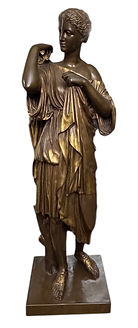
Antique bronze art appraisal - ‘’Diana of Gabii’ - Antique Barbedienne Foundry bronze figurative sculpture, of gold highlighted brown patina, artist signed and foundry stamped, circa 1870, approx. 22½” tall.
The Barbedienne Foundry, formally known as Fonderie d’Art Barbedienne, stands as one of the most celebrated and influential art foundries in the history of European sculpture. Founded in Paris in the mid-19th century by Ferdinand Barbedienne, the enterprise revolutionized the art of bronze casting, bridging the gap between fine art and industrial production. Through its technical innovations, commitment to artistic excellence, and collaboration with many of the greatest sculptors of its era, the Barbedienne Foundry helped democratize access to art while setting enduring standards of craftsmanship.
Ferdinand Barbedienne (1810–1892) was born in Calvados, Normandy, and began his career as a wallpaper dealer in Paris. His introduction to the world of sculpture came through collaboration with Achille Collas (1795–1859), an engineer and inventor who developed an innovative mechanical process for reproducing sculptures in smaller, precise proportions. Collas’s réducteur mécanique could copy any three-dimensional object at reduced scales, preserving the form and detail of the original.
In 1838, Barbedienne recognized the commercial and artistic potential of Collas’s device. Together, they founded the firm Société Collas et Barbedienne, combining industrial technique with artistic sensibility. Initially, the company specialized in miniature bronze reproductions of classical antiquities, particularly those held in European museums such as the Louvre, the British Museum, and the Vatican. These small bronzes allowed art lovers, scholars, and the growing bourgeois middle class to own replicas of famous masterpieces that had previously been accessible only to elite collectors or institutions.
The Barbedienne Foundry’s early success coincided with a broader 19th-century movement toward industrial art — the use of new technologies to make beauty and design available to a wider public. Barbedienne’s mission was both commercial and cultural: he believed that art should adorn not only the palaces of the wealthy but also the homes of educated citizens. His company produced not just statues but also decorative bronzes such as candelabra, clocks, furniture mounts, and architectural ornaments.
By the mid-19th century, Barbedienne had become a key figure in what was called l’art industriel — the fusion of art, craftsmanship, and industry. His bronzes were shown at major international exhibitions, including the Exposition Universelle in Paris (1855, 1867, 1878, and 1889), where he received numerous medals for quality and innovation. The firm’s work exemplified the optimism of the industrial age: the belief that technology could serve beauty and elevate public taste.
Beyond reproducing classical works, Barbedienne established close partnerships with living sculptors, casting their original models in bronze with exceptional precision. This collaboration transformed the foundry into a vital link between creative conception and material realization.
Among the artists whose works were cast by Barbedienne were some of the most renowned names in 19th-century sculpture: Jean-Baptiste Carpeaux, Antoine-Louis Barye, François Rude, and Auguste Rodin. Barbedienne’s foundry translated their clay or plaster models into enduring bronze, ensuring both technical perfection and faithful expression of the artist’s intent.
For example, Antoine-Louis Barye’s dynamic animal bronzes — lions, tigers, and mythological creatures — reached a wider audience thanks to Barbedienne’s reproductions. Similarly, Carpeaux’s expressive figures, such as La Danse and Ugolin et ses fils, were reproduced in multiple sizes for collectors. The foundry’s signature on the base of a sculpture, F. Barbedienne, Fondeur, became synonymous with quality and authenticity.
The Barbedienne Foundry was celebrated for its technical mastery. The firm employed both the traditional lost-wax (cire perdue) casting method and modern sand casting, depending on the size and complexity of the sculpture. The artisans of the foundry — modelers, chasers, and patineurs — were among the best in Paris.
Particularly admired was the foundry’s ability to achieve subtle, richly varied patinas, ranging from warm browns and greens to deep blacks and gold tones. Barbedienne’s patinas were not merely protective finishes but artistic expressions that enhanced the aesthetic impact of the bronze. The company often used chemical treatments to produce hues resembling those of ancient statuary, reinforcing the association between its modern works and classical heritage.
Barbedienne also invested heavily in machinery and precision tools, ensuring consistency in reproduction while maintaining artistic quality. He combined industrial discipline with artisanal skill — a dual approach that distinguished his foundry from purely mechanical manufacturers. The company employed hundreds of workers at its peak, operating a large workshop complex on Rue de Lancry and later Rue de Bonaparte in Paris.
After Achille Collas’s death in 1859, Barbedienne continued to expand the business. He obtained exclusive rights to reproduce numerous classical statues from European museums, as well as contemporary works by major sculptors. His catalogues listed hundreds of items, from miniature busts to monumental public sculptures.
During the Second Empire (1852–1870), Barbedienne’s bronzes adorned public buildings, royal residences, and international exhibitions. Emperor Napoleon III commissioned works from the foundry for the decoration of the Louvre and other state projects. The firm also supplied artistic metalwork for furniture makers such as Édouard Lièvre and for architects designing opulent interiors.
When Ferdinand Barbedienne died in 1892, he was widely recognized as a pioneer who had elevated industrial art to a level of true artistry. His nephew and successor, Gustave Leblanc-Barbedienne, took over the management and maintained the company’s prestige into the early 20th century. Under his leadership, the foundry cast large-scale monuments for sculptors such as Auguste Rodin and Emmanuel Frémiet, contributing to the bronze statuary that filled Parisian squares and parks.
As artistic tastes shifted in the early 20th century, the demand for classical reproductions declined, and the foundry gradually reduced production. Nevertheless, it remained active until 1952, when it finally closed its doors after more than a century of operation. By that time, the Barbedienne name had become a mark of excellence, sought after by collectors and curators worldwide.
Today, Barbedienne bronzes are prized in museums and private collections for their quality and historical significance. The foundry’s mark — often inscribed simply as “F. Barbedienne, Fondeur” — guarantees authenticity and continues to command respect in the art market. Many of the firm’s 19th-century reproductions of ancient masterpieces, such as the Venus de Milo and Apollo Belvedere, are themselves considered works of art, embodying the aesthetic ideals of their time.
The legacy of the Barbedienne Foundry extends beyond its technical achievements. It represents a crucial chapter in the democratization of art and the evolution of modern industry. By using technology to reproduce fine sculpture with fidelity and beauty, Barbedienne blurred the boundaries between artisan and manufacturer, between unique creation and serial production. His enterprise anticipated modern debates about art, authenticity, and mass culture.
Barbedienne also played a pivotal role in preserving the works of great sculptors. Through his reproductions, he ensured that the masterpieces of both antiquity and modernity could survive in countless copies, inspiring artists, students, and the public across generations. The foundry’s blend of aesthetic refinement and industrial prowess embodied the 19th century’s belief that art and progress were inseparable forces in the advancement of civilization.
The Barbedienne Bronze Art Foundry remains one of the defining institutions of 19th-century artistic industry. Founded on the partnership between an inventor and an entrepreneur, it united innovation with beauty, craftsmanship with commerce. From the quiet precision of its miniature bronzes to the grandeur of its monumental casts, every work bearing the Barbedienne name reflects a remarkable synthesis of technology and artistry. More than a business, the Fonderie d’Art Barbedienne was a cultural mission — to make art eternal, reproducible, and universally accessible. Its influence endures in the history of sculpture, industrial design, and the continuing dialogue between art and industry.


Comments